
Medically Reviewed by Dr. Ayush Chandra, MBBS
Swollen legs can have a dozen explanations, and liver disease isn’t usually the first one people think of. But for some, that’s exactly where it starts — quietly, often before any other symptom shows up, which is part of why it tends to get missed early on.
As Dr. Ayush Chandra puts it,
“Leg swelling on its own doesn’t point to the liver specifically. It’s the pattern around it — how it looks, what else is going on — that usually gives the real clue.”
What Liver Conditions Can Cause Leg Swelling?
Leg swelling associated with the liver is most often connected to cirrhosis – a progressive scarring of the liver that eventually impairs how effectively it works. As liver function decreases, the amount of albumin produced also declines, which is a protein responsible for maintaining correct amounts of fluid in blood vessels. When there is less albumin in the bloodstream, fluids will escape from blood vessels into tissues, first being noticed in the legs and ankles.
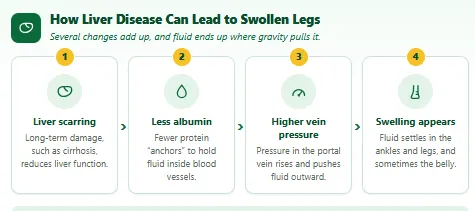
Cirrhosis also raises pressure in the portal vein, the large vessel that carries blood from the digestive organs to the liver. With scar tissue blocking the flow, pressure builds up and pushes more fluid out of the blood vessels, which adds to the swelling. Cirrhosis isn’t the only route, either. Long-standing hepatitis, fatty liver disease that has progressed, and bile duct problems can all end up in the same place once they start to affect how the liver works.
Because heart, kidney and vein problems can cause swelling that looks almost identical, the legs alone can’t tell anyone what is going on. Working out the real cause is a big part of a liver evaluation.
Quick Note: Leg swelling by itself doesn’t confirm a liver problem — it needs a proper clinical workup to tell it apart from other, more common causes.
What Other Symptoms May Occur With Liver-Related Leg Swelling?
Liver-related swelling rarely shows up completely alone. A yellowish tint to the skin or eyes (jaundice), unusual fatigue, itchy skin, or a swollen, fluid-filled abdomen — known as ascites — often appear alongside it, especially as liver function declines further. Some people also notice easy bruising, darker urine, or a loss of appetite.
Abdominal Swelling
Fluid buildup in the belly (ascites) frequently accompanies liver-related leg swelling.
Persistent Fatigue
Tiredness that doesn’t improve with rest can point to an underlying liver issue
Quick Note: One symptom alone rarely confirms liver involvement — it’s the combination, assessed together, that guides diagnosis.
How Is Leg Swelling Caused by Liver Disease Treated?
Treatment usually targets the liver condition behind the swelling rather than the swelling alone. For cirrhosis, that can mean stopping alcohol where it is a factor, treating viral hepatitis, or managing fatty liver disease. Fatty liver often goes hand in hand with diabetes and excess weight, so blood sugar and weight management through diabetes care frequently become part of the plan.
Usually, when the doctor gives advice regarding treatment sodium is the first thing to be reduced, as salt makes the body hold water. Diuretic medicine is usually prescribed in this case, which should only be given by a doctor; self-dosing is absolutely forbidden due to harmful effects on kidneys and electrolytes. Lying with legs elevated and wearing compression stockings (under the doctor’s advice) can be helpful for mild swelling.
Quick Note: Diuretics and dietary changes help manage symptoms, but they don’t replace treating the liver condition driving them.
When Does Leg Swelling With Liver Disease Require Medical Attention?
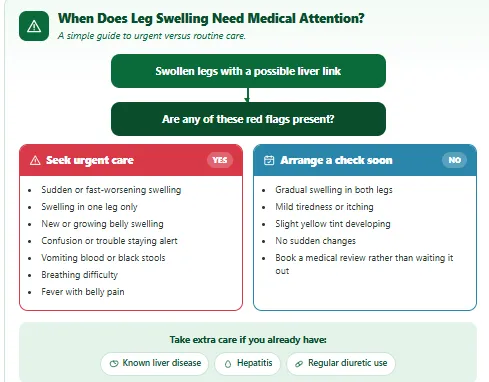
Leg swelling that appears gradually alongside other liver-related symptoms is worth discussing with a doctor fairly soon, rather than waiting to see if it resolves on its own.
Certain scenarios require immediate attention. They include sudden or escalating swelling; swelling in one leg only, as this may indicate a clot, rather than a liver condition; sudden abdominal swelling; confusion or drowsiness; yellowing of the skin (or the eyes); vomiting blood or having dark stools; and the presence of swelling along with difficulty breathing. Fever combined with pain and swelling in the abdomen should also alert the individual, as it may indicate infection in fluid in the abdomen.
This isn’t meant to cause alarm — many cases of liver-related swelling are managed effectively with ongoing care. But some of these signs point to complications that shouldn’t wait for a routine appointment.
Quick Note: One-sided leg swelling, confusion, or vomiting blood are not symptoms to monitor at home — they need prompt medical evaluation.
Noticing leg swelling along with fatigue, jaundice, or abdominal bloating? Book a consultation to get it properly assessed.
FAQ'S
Can liver disease cause swelling in just one leg?
Not usually. Swelling that develops in the legs, which is related to the liver, usually appears simultaneously in both legs. If the swelling is in one leg, it is likely that the swelling is caused by a blood clot or vein issues; it is not caused by the liver, so you should seek medical attention as soon as possible for the blood clot.
Does swelling of legs only occur in liver failure?
Not always. It can also occur prior to the development of liver failure – when the liver is starting to fail – which is not just a late stage disease. Its appearance differs in individual people, it may be early or late.
Is it possible to reduce the swelling without medication?
Yes, to a certain degree. Limit salt, raise legs when resting to help minimize some mild swelling. In most cases, however, if the liver is responsible for the fluid retention, it’s not enough to just use those treatments; medical management must be used as well.
What are the differences between liver swelling and heart or kidney swelling?
Come on, they can be virtually indistinguishable at a glance. Doctors make a diagnosis based on the pattern of symptoms, imaging and blood tests, and not just the swelling.
If my swelling improves, will I be able to just discontinue my diuretic?
It’s best not to. Be aware that if you seem to be feeling better, you should not change or stop your diuretic dose without talking to your doctor as it can cause your kidneys and your electrolyte levels to become unbalanced. This is a choice that is made by your doctor, and not yours.
References:
- Mayo Clinic — Cirrhosis: Symptoms and Causes — https://www.mayoclinic.org/diseases-conditions/cirrhosis/symptoms-causes/syc-20351487
- MedlinePlus (National Library of Medicine) — Edema — https://medlineplus.gov/edema.html