
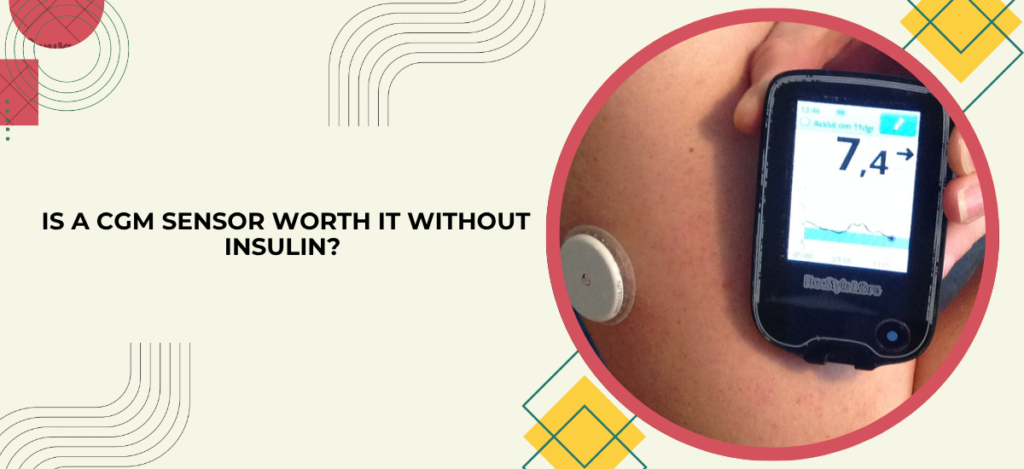
For most people who aren’t on insulin, a CGM sensor isn’t medically necessary, and the cost usually outweighs what it adds. That said, it’s not a flat no across the board. There are specific situations, unstable sugars, a pre-diabetes diagnosis, or just wanting to understand your own patterns, where it can still be genuinely useful, just not in the way insulin users rely on it.
Dr. Ayush Chandra, diabetologist in Ghaziabad, puts it plainly: “A CGM without insulin isn’t pointless, but it’s a different tool for a different job. It’s less about dosing decisions and more about learning your own patterns.”So the real question isn’t whether CGM works. It’s whether you actually need what it’s offering.
When a CGM Actually Adds Value Without Insulin
There are a handful of situations where it earns its cost even for non-insulin users, and they’re fairly specific.
- If your sugars swing more than they should on oral medication alone, a CGM can pick up patterns a single morning finger-prick would completely miss. That’s the same idea we covered in What Is Continuous Glucose Monitoring?, just applied to a non-insulin case.
- People recently diagnosed with prediabetes sometimes use a CGM short-term just to see how specific meals actually affect them. Once that learning happens, most don’t need to keep wearing one long-term.
- If weight loss is part of the picture, especially alongside GLP-1 therapy, some patients like seeing how their glucose responds as the medication kicks in. Our GLP-1 Treatment page touches on how monitoring fits into that combination.
- And for people managing diabetes through diet and lifestyle changes rather than medication, a short CGM trial can occasionally reveal which foods are actually the problem, something that’s easy to guess wrong about.
Why It Usually Isn’t Worth It for Most Non-Insulin Users
For the average person managing Type 2 diabetes with oral medication and reasonably stable sugars, the case gets a lot weaker.
- The cost is real and ongoing. Sensors need replacing every couple of weeks, and insurance in India rarely covers it for non-insulin patients, so it adds up fast for information that doesn’t usually change your treatment plan.
- If your HbA1c is well controlled and your sugars aren’t doing anything unpredictable, a CGM mostly just confirms what you already know. It’s data without a decision attached to it, which is a different situation from insulin users, where the numbers directly change dosing in real time.
- Stable patients often find the novelty wears off within weeks. The first sensor is interesting for the first ten days, then it becomes routine, and the actual clinical value plateaus quickly for someone whose diabetes is already well managed. Our Diabetes Treatment page covers what ongoing monitoring actually looks like for stable Type 2 patients, which usually doesn’t need to be this granular.
- Finger-prick testing already does the job for most of this group. A couple of readings a week is generally enough to confirm things are staying on track, so the extra granularity a CGM offers doesn’t translate into extra benefit for someone whose numbers aren’t moving much anyway.
Why Choose Nivaran Health for Diabetes Monitoring Decisions?
Dr. Ayush Chandra brings sixteen years of experience treating diabetes and metabolic conditions, trained at CMC Vellore with additional certifications from the Royal Liverpool Academy and Cleveland Clinic. Whether or not a CGM makes sense for you isn’t a blanket recommendation here, it’s based on your actual sugar patterns and treatment plan.
The approach stays honest rather than upsell-driven. If finger-prick testing is genuinely enough for your situation, that’s what gets recommended, not a sensor you don’t need.
Not sure if a CGM is worth it for your situation? Talk to Dr. Ayush Chandra about what your actual sugar patterns suggest.
FAQs
Can I use a CGM if I’m only on oral diabetes medication?
Yes, there’s nothing stopping you, it’s just not always necessary. It tends to help most when sugars are unstable or when you’re trying to understand specific patterns.
Is CGM data useful if I’m not adjusting insulin doses with it?
It can still be useful for spotting trends and food reactions, but without insulin dosing tied to it, the day-to-day value is smaller.
How much does a CGM sensor typically cost in India?
It varies by brand, but expect an ongoing cost every couple of weeks since sensors aren’t reusable, and most plans don’t cover it for non-insulin patients.
Should prediabetics get a CGM?
A short trial can be genuinely useful for learning how specific foods affect your sugar, though most people don’t need to wear one long-term.
Disclaimer
This blog is for informational purposes only and should not be taken as a final diagnosis or treatment plan.
Reference Links